Femipro Official Website › Reading room › Femipro Probiotic
Femipro Probiotic (2026): Five Strains, No Colony Count
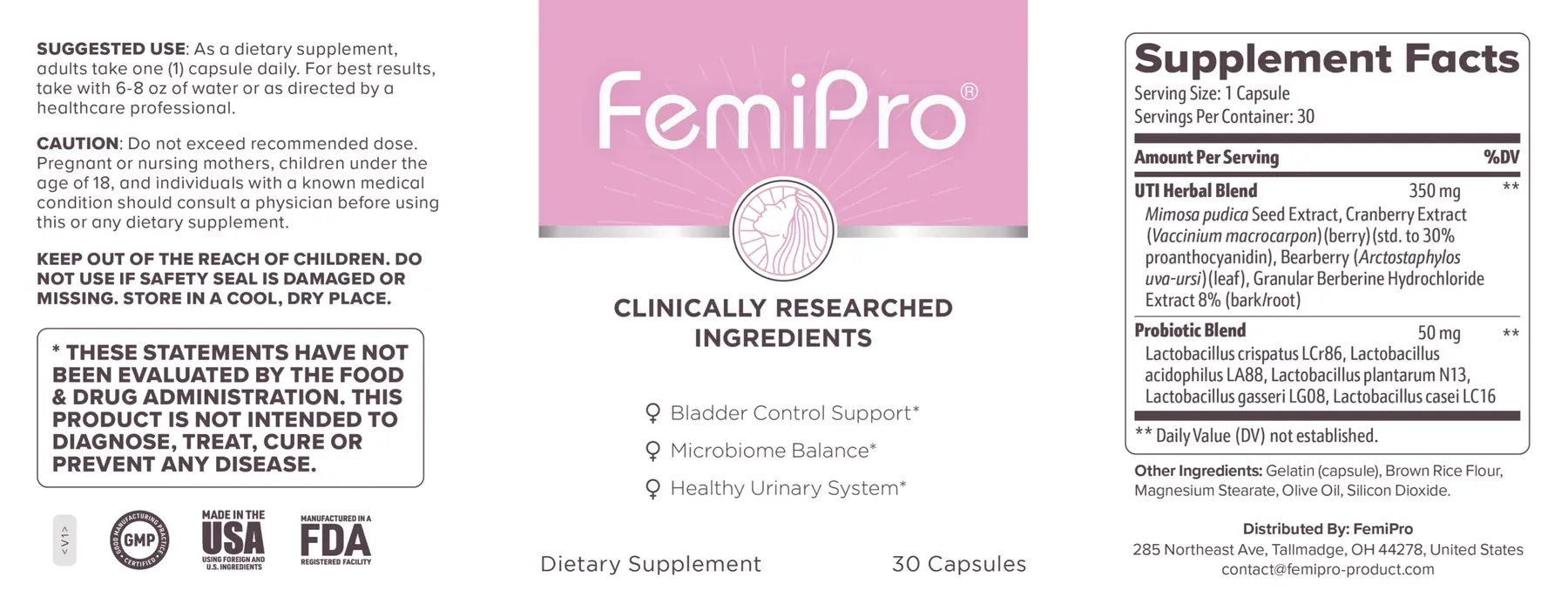
The Femipro probiotic is a 50 mg blend of five Lactobacillus strains inside a gelatin capsule, taken once a day. The label names every strain by code but prints no colony count and no amount per strain. Femipro itself has never been tested in a trial, so treat the probiotic side as unproven.
Want to see today’s price before you decide?
The checkout page prints the live price for each pack and the 60-day guarantee terms. Reading it costs nothing and commits you to nothing.
$49 to $69 a bottle · free US shipping · 60-day guarantee
See today’s price and guaranteeDisclosure: this site earns when you buy through its order links, which are marked sponsored.
- The Femipro probiotic blend weighs 50 mg per capsule, next to a 350 mg herbal blend.
- Five strains are named: L. crispatus LCr86, L. acidophilus LA88, L. plantarum N13, L. gasseri LG08 and L. casei LC16.
- No colony count (CFU) and no amount per strain is published.
- One capsule a day with 6 to 8 oz of water; 30 capsules in a bottle.
- The shell is gelatin, so the capsule is not vegetarian or vegan.
- Store in a cool, dry place; do not use if the safety seal is damaged or missing.
Femipro is a dietary supplement. It is not FDA approved, and no dietary supplement is. It does not treat, cure or prevent any disease, and it is not a treatment for a urinary tract infection. Take medical questions to your doctor or pharmacist.
What is the Femipro probiotic blend?
The Femipro probiotic is one of two blends in every capsule. The other is a 350 mg herbal blend of cranberry, bearberry, berberine and mimosa pudica. The probiotic blend weighs 50 mg and holds five Lactobacillus strains. That makes it about one eighth of the 400 mg of blends in a capsule.
The bottle prints three claim lines on the front: Bladder Control Support, Microbiome Balance and Healthy Urinary System. The Femipro probiotic sits behind the second line. These lines describe support for normal function. They do not say the capsule treats or prevents anything, and Femipro is not FDA approved, as no supplement is.
Which five strains are in the Femipro probiotic?
The panel lists the strains in full, each with a code. That is more detail than many bottles in this aisle give, because they often name a species and stop. The five are:
- Lactobacillus crispatus LCr86
- Lactobacillus acidophilus LA88
- Lactobacillus plantarum N13
- Lactobacillus gasseri LG08
- Lactobacillus casei LC16
The names run in descending order by weight, as labelling rules require. So crispatus LCr86 outweighs casei LC16. That is all the order tells you. It does not give a number for any strain.
Why does a strain code matter? Probiotic effects are tied to the exact strain, not just the family name. A code lets you ask a maker for data on that strain. Whether the maker has any data for these codes is not published on this website.
How much Femipro probiotic is in one capsule?
The blend total is 50 mg. If the five strains shared it evenly, each would be about 10 mg. The label does not say they do, so treat that figure as simple arithmetic and nothing more.
The bigger gap is the colony count. Probiotics are dosed in colony forming units, the number of live organisms in a serving. Milligrams describe the weight of the powder, not how much of it is alive. The Femipro label prints no colony count for the blend or for any strain. Our post on CFU, not milligrams explains why that number matters most.
Without it you cannot compare this bottle with another product or with a study. You can only judge it on your own routine, and the 60-day guarantee exists for that reason.
| Detail | On the label? |
|---|---|
| Probiotic blend total (50 mg) | Printed |
| Five strain names with codes | Printed |
| Amount of each strain | Not published |
| Colony count (CFU) per capsule | Not published |
| Third-party test mark | Not published |
| Certificate of analysis document | Not published (only a reference number is held) |
Does a capsule suit the Femipro probiotic?
A capsule shell gives live bacteria some protection on the way through the stomach, which a chewable does not. It also keeps sugar off the label, since there is no syrup to carry a flavour. The cost is that you must swallow it, and the shell is gelatin, which comes from animals.
There is a research point to keep in mind too. The two positive L. crispatus trials used a vaginal suppository, not something swallowed. We wrote about that in why the probiotic trials used a suppository. The route matters, and nobody has tested the Femipro capsule itself.
How should you store and take the Femipro probiotic capsule?
Take one capsule a day with 6 to 8 oz of water. That is the whole label direction. The label sets no time of day, so choose one you will not forget. Do not take more than the label says.
The capsule holds live bacteria, so storage matters. The label says to keep it in a cool, dry place. A bathroom cabinet above a shower swings between warm and humid, which makes it a poor choice. A kitchen cupboard away from the hob is better. Check that the safety seal is intact before you open a new bottle.
Who should ask first before trying the Femipro probiotic?
The label tells pregnant or nursing mothers, anyone under 18 and anyone with a known medical condition to consult a physician before use. Skip the capsule if you avoid animal products, because of the gelatin shell. The herbal half holds berberine, which can change how the body clears some medicines, so tell a pharmacist about anything you take.
Burning that gets worse, fever, back or flank pain, or blood in the urine are not supplement questions. They need a clinician the same day.
Frequently asked questions
What is in the Femipro probiotic?
Five Lactobacillus strains in a 50 mg blend: L. crispatus LCr86, L. acidophilus LA88, L. plantarum N13, L. gasseri LG08 and L. casei LC16.
How many CFU does the Femipro probiotic have?
The label does not say. It prints a 50 mg blend total but no colony count, so the number of live organisms is not published.
Is the Femipro probiotic proven to work?
No. Femipro has never been the subject of a clinical trial. The research cited on this website covers single ingredients and individual strains, not the finished capsule.
Does the Femipro probiotic need to be kept cold?
The label says to store it in a cool, dry place. It does not ask for a refrigerator. Avoid hot, humid spots such as a bathroom cabinet.
Can vegetarians take the Femipro probiotic?
No. The capsule shell is gelatin, which is animal-derived, even though one seal on the sales material says vegetarian.
When do buyers on this site report a change?
Buyers who report a change most often put it at 4 to 8 weeks. Individual results vary, and the 60-day guarantee runs from the purchase date.
Our view
We think the Femipro probiotic is a fair idea with too little detail. The strain codes are a real point in its favour. The missing colony count is the real weakness, because it is the one number that tells you the dose.
If you try it, treat it as a daily habit you will judge fairly, keep the bottle somewhere cool and dry, and decide by day 50 so you stay inside the 60-day guarantee. Do not buy it expecting a fix. Ask a clinician about anything that worries you.
Read more in the Femipro ingredients page and CFU, not milligrams.
Decided it is worth a careful try?
Three bottles cover 90 days, which fits the 4 to 8 weeks in which buyers here report a change. The checkout shows today’s price.
$49 to $69 a bottle · free US shipping · 60-day guarantee
See today’s price and guaranteeDisclosure: this site earns when you buy through its order links, which are marked sponsored.
Last updated October 30, 2026. Written by the Femipros Editorial Team and medically reviewed by Dr. Jennifer Roelands, MD on October 30, 2026. General information only; it does not replace a clinician who knows your history.

Dr. Jennifer Roelands, MD, Physician, reviews the pages on this site. We write from the printed Femipro bottle and its Supplement Facts panel, cite public research by name, and print “not published” wherever the label gives no figure. Review date for this post: October 30, 2026. Questions or corrections: [email protected].