Femipro Official Website › Safety and interactions
Femipro Safety, Side Effects And Medicine Interactions
Two ingredients in Femipro carry real cautions. Berberine inhibits CYP3A4 and P-glycoprotein and can raise blood levels of several prescription medicines. Bearberry is excreted as hydroquinone and has traditionally been limited to short courses. Neither amount is published. Show the panel to a pharmacist before the first capsule.
Not a disclaimer page. Two specific ingredients, the actual studies, and what to do about each.
Berberine, and why Femipro needs a pharmacist’s opinion
One ingredient, four medicine classes, and two real human studies.
Berberine is the reason this page exists. It is a plant alkaloid with real pharmacology, and the pharmacology that matters here is not what it does to you but what it does to your other medicines.
It inhibits CYP3A4 and P-glycoprotein. Those are, between them, the machinery your body uses to metabolise and pump out a very long list of drugs. Inhibit them and blood levels of those drugs rise. The most comprehensive pharmacokinetic review of berberine states directly that co-administration with metformin, ciclosporin and digoxin “may result in important interactions”.
The human data is thin but it is real. A study in healthy volunteers gave berberine 0.3 g twice daily and found ciclosporin exposure rose by 19 percent. It is a small study, twelve people across two arms, and you should weigh it as such. More recently, a three-arm crossover trial in adults with type 2 diabetes demonstrated a dose-dependent pharmacokinetic interaction between metformin and goldenseal, which is a berberine-containing plant rather than isolated berberine hydrochloride, so it is supportive by analogy rather than directly.
Berberine also lowers blood glucose in its own right. The best meta-analysis of berberine trials is about lipids, and the wider literature on its metabolic activity is substantial. For anyone managing blood sugar, an unquantified addition to the regimen is not a neutral thing.
| If you take | The concern | What to do |
|---|---|---|
| Ciclosporin or another transplant medicine | Directly studied. Berberine raised exposure by 19 percent in healthy volunteers, attributed to CYP3A4 inhibition. | Do not start this without your transplant team's agreement. |
| Metformin or another glucose-lowering drug | A dose-dependent interaction with a berberine-containing plant has been demonstrated, and berberine lowers glucose independently. | Raise it with whoever manages your diabetes before the first capsule. |
| A statin | Most statins are CYP3A4 substrates. Raised levels raise the risk of muscle side effects. | Ask a pharmacist. This is a two-minute conversation. |
| Digoxin | Named in the pharmacokinetic review as a potential interaction, and it has a famously narrow therapeutic window. | Do not start without asking the prescriber. |
| A blood thinner | Not a berberine issue directly, but NCCIH notes conflicting evidence on cranberry and warfarin. | Mention both the cranberry and the berberine when you ask. |
| Anything else on prescription | CYP3A4 handles a large share of all medicines. The list above is not exhaustive and cannot be. | Take the bottle to a pharmacy counter. They will read the panel in a minute. |
The amount of berberine in a 350 mg four-way blend is probably modest. Probably is doing a lot of work in that sentence, because the label does not publish the figure and nobody outside the manufacturer can.
The FDA’s own consumer guidance on mixing medications and dietary supplements exists because these combinations can have dangerous, even life-threatening, effects, and because “natural” guarantees nothing about safety. It is a short page and it is worth five minutes.
Bearberry, hydroquinone, and how long a Femipro course should run
A real mechanism, a real limit, and a trial nobody in this category quotes.
Bearberry leaf contains arbutin. The body converts it and excretes it into urine, largely as hydroquinone and its conjugates. That conversion is the proposed mechanism, and it is also the reason every traditional monograph on uva-ursi puts a limit on how long a course should last.
The pharmacokinetics are established. A crossover study in 16 healthy volunteers recovered about 65 percent of an administered arbutin dose in urine as hydroquinone equivalents, with wide variation between individuals. Hydroquinone is not a substance anyone wants indefinite exposure to.
How much does that matter at supplement doses? A published risk assessment estimates that a therapeutic daily dose produces free-hydroquinone exposure well below the derived permitted level, and finds no direct human evidence of liver toxicity, kidney toxicity or tumour promotion. We cite it because it is the best available assessment and because withholding it would be dishonest. Two things should be said alongside it: all three authors were employed by a bearberry product manufacturer, and the assessment addresses short-term recommended use. Six consecutive bottles is not short-term use, and that scenario has not been assessed by anybody.
The label prints no duration limit. That is worth stating plainly, because a buyer who has read anything about uva-ursi will expect one. Every serious herbal monograph caps a course at roughly a week and a handful of courses a year, on the hydroquinone grounds above. This bottle carries the general caution and the storage line and nothing about how long to take it, and it is sold in six-bottle packs that cover 180 consecutive days. We are not claiming that is unsafe at whatever unstated fraction of 350 mg is in a capsule. We are saying nobody has assessed it, the label does not raise it, and you now know to.
There is a second reason to be careful with bearberry, and it is the one the category never mentions. It is the only ingredient on this panel with a randomised trial that went the wrong way. REGATTA found more pyelonephritis on uva-ursi than on an antibiotic, eight cases against two, and a higher symptom burden. ATAFUTI found no benefit at all. Those trials used therapeutic bearberry doses in women with an active infection, which is not what this product is or what it is for, so they do not transfer directly. They do mean that bearberry is not a harmless traditional herb with nothing but upside.
Femipro side effects, and what to do about each
Six things, and the last row of the second box is the important one.
| Effect | How likely | What to do |
|---|---|---|
| Mild digestive upset in the first week | The commonest thing reported for capsules of this type. | Take it with food rather than on an empty stomach. If it persists past a week, stop. |
| Loose stools | Plausible from either the probiotic fraction or the berberine. | Usually settles. If it does not, stop and use the guarantee. |
| Darker urine | Berberine is an intensely yellow pigment. | Cosmetic, and not a cause for concern on its own. Blood in the urine is a different matter and needs a clinician. |
| Nausea | Occasionally reported with berberine-containing products. | Take with a full meal. If it continues, stop. |
| Lower blood glucose than usual | Berberine has glucose-lowering activity. | Relevant mainly if you are treating diabetes. Monitor, and speak to whoever manages it. |
| An allergic reaction | Rare, but possible with any botanical. | Stop immediately. Seek urgent care for swelling, a rash that spreads, or any difficulty breathing. |
This desk has received no adverse-event reports for this stock. That is a statement about our own record across a limited number of orders, not a safety finding, and it should not be read as one.
Burning that is getting worse, fever, shivering, pain in the back or flank, or blood in the urine can indicate an infection that has reached a kidney. That is not a supplement reaction and it is not something to wait out. Contact a clinician the same day.

Every page, every journal post, the bottle facts and the ingredients go through review by Dr. Jennifer Roelands, MD before they ship. We write these pages from the printed Femipro bottle and from the Supplement Facts panel photographed in our own stock images, cite public research for cranberry, bearberry, berberine, mimosa pudica and the named lactobacillus strains, and print “not published” wherever a figure is not disclosed rather than estimating it. This label publishes two blend totals and no individual amount, and that fact appears on every page where an ingredient is named. Where the seller’s marketing claims more than the bottle supports, we say so on the page. Corrections are made on the page itself and the review date moves forward. Write to [email protected]. Last reviewed September 2026 by Dr. Jennifer Roelands, MD.
Sources for Femipro safety
- Khoshandam, berberine pharmacokinetics, 2022. Khoshandam A, Imenshahidi M, Hosseinzadeh H. Pharmacokinetic of berberine, the main constituent of Berberis vulgaris L.: a comprehensive review. Phytotherapy Research. 2022;36(11):4063-4079. View source
- Xin, berberine raises ciclosporin levels, 2006. Xin HW, Wu XC, Li Q, Yu AR, Zhong MY, Liu YY. The effects of berberine on the pharmacokinetics of cyclosporin A in healthy volunteers. Methods and Findings in Experimental and Clinical Pharmacology. 2006;28(1):25-29. View source
- Nguyen, goldenseal and metformin crossover trial, 2025. Nguyen JT, Tian DD, Kellogg JJ, et al. The pharmacokinetic interaction between metformin and the natural product goldenseal is metformin dose-dependent: a three-arm crossover study in adults with type 2 diabetes. Clinical and Translational Science. 2025;18(2):e70120. The botanical tested was goldenseal, a berberine-containing plant, not isolated berberine hydrochloride. View source
- Blais, berberine meta-analysis, 2023. Blais JE, Huang X, Zhao JV. Overall and sex-specific effect of berberine for the treatment of dyslipidemia in adults: a systematic review and meta-analysis of randomized placebo-controlled trials. Drugs. 2023;83(5):403-427. View source
- Schindler, arbutin excreted as hydroquinone, 2002. Schindler G, Patzak U, Brinkhaus B, et al. Urinary excretion and metabolism of arbutin after oral administration of Arctostaphylos uvae ursi extract as film-coated tablets and aqueous solution in healthy humans. Journal of Clinical Pharmacology. 2002;42(8):920-927. View source
- de Arriba, hydroquinone risk assessment, 2013. de Arriba SG, Naser B, Nolte KU. Risk assessment of free hydroquinone derived from Arctostaphylos uva-ursi folium herbal preparations. International Journal of Toxicology. 2013;32(6):442-453. All three authors were employed by a bearberry product manufacturer. View source
- REGATTA trial, uva-ursi versus fosfomycin, 2021. Gagyor I, Hummers E, Schmiemann G, et al. Herbal treatment with uva ursi extract versus fosfomycin in women with uncomplicated urinary tract infection in primary care: a randomized controlled trial. Clinical Microbiology and Infection. 2021;27(10):1441-1447. View source
- ATAFUTI trial, uva-ursi and ibuprofen, 2019. Moore M, Trill J, Simpson C, et al. Uva-ursi extract and ibuprofen as alternative treatments for uncomplicated urinary tract infection in women (ATAFUTI): a factorial randomized trial. Clinical Microbiology and Infection. 2019;25(8):973-980. View source
- NCCIH, cranberry usefulness and safety. National Center for Complementary and Integrative Health. Cranberry: Usefulness and Safety. National Institutes of Health. View source
- FDA, mixing medicines and supplements. U.S. Food and Drug Administration. Mixing Medications and Dietary Supplements Can Endanger Your Health. View source
- NCCIH, using dietary supplements wisely. National Center for Complementary and Integrative Health. Using Dietary Supplements Wisely. National Institutes of Health. View source
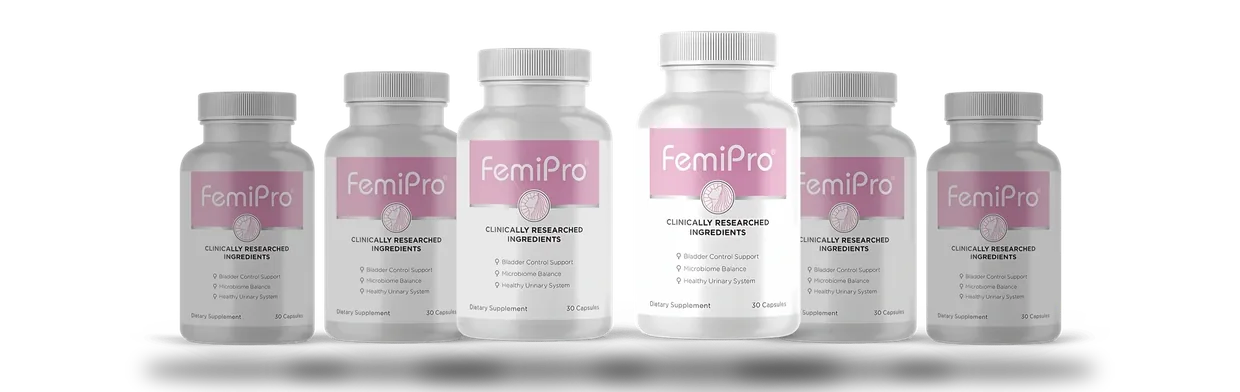
Order Femipro once you have checked the panel
If you take prescription medicine, the pharmacy counter first and the checkout second. The 60-day guarantee covers a change of mind; it does not cover an interaction.
$49 to $69 a bottle · 60 days to change your mind
Order Femipro On The Official WebsiteOne-time payment, no subscription · free US shipping · 60-day money-back guarantee · lot FEM-26/FE-4936 · tracking and refunds +1 (302) 200-3480