Femipro Official Website › Reading room
CFU, Not Milligrams: How To Read A Probiotic Label
- Milligrams measure powder. Colony forming units measure living organisms.
- 50 mg of one probiotic preparation can hold a hundred times the organisms of 50 mg of another.
- A label with no CFU figure cannot be compared with any other probiotic on the shelf.
- Ask when the count is guaranteed, at manufacture or at expiry. Only one of those is the number you will swallow.
Two numbers that are not the same number
If you pick up two probiotic products, one saying 50 mg and one saying 10 billion CFU, you have been given two numbers that measure different things and cannot be converted into one another.
Milligrams are a weight. They tell you how much material is in the capsule.
Colony forming units are a count of viable organisms: bacteria capable of dividing and forming a colony on a plate. For a probiotic, that is the dose, because a dead lactobacillus is a protein and not a probiotic.
The relationship between the two depends entirely on how concentrated the preparation is, and that varies enormously. A freeze-dried, highly concentrated culture and a culture diluted heavily in a carrier can weigh the same and differ by orders of magnitude in what they contain. This is not a subtlety at the edges; it is the difference between a product that could plausibly do something and one that could not.
What is actually in a probiotic powder
A probiotic ingredient is rarely just bacteria. Typically it contains:
- The organisms themselves, usually freeze-dried
- Residual growth medium, the material they were cultured on
- A cryoprotectant, often a sugar, which protects the cells during freeze-drying
- A carrier or diluent, to bring the batch to a standard concentration and make it possible to dose accurately
- Sometimes a coating, to improve survival through the stomach
Every one of those weighs something, and every one is included in a milligram figure. So a 50 mg probiotic blend might be mostly organisms or mostly carrier, and the label gives you no way to tell. That is why serious probiotic products print a CFU count, and why a milligram-only label is a weaker disclosure than it looks.
| Product A | Product B | |
|---|---|---|
| Printed amount | 50 mg probiotic blend | 50 mg probiotic blend |
| Strains named? | Yes, five | Yes, five |
| CFU printed? | No | Yes, 10 billion |
| What you can compare | Nothing | The dose, against any other product |
| What you are trusting | That the blend is concentrated | A stated, checkable figure |
| Could these be 100x apart? | Yes, and you could not tell | No, because one of them is stated |
At manufacture, or at expiry
Here is the second question, and it catches out people who have already learned the first one.
Live organisms die in storage. A probiotic loses viability over its shelf life, faster if it is warm or humid. So a CFU count is only meaningful with a date attached to it, and there are two conventions:
- At time of manufacture. The flattering number. It tells you what was in the capsule on the day it was filled and nothing about what is in it now.
- At expiry, or through end of shelf life. The useful number. It is a guarantee that the stated count will still be there on the last day you could take it.
The difference is not small. A product can honestly print a large at-manufacture figure and deliver a fraction of it by the time you buy it. A product guaranteeing the count at expiry has committed to overfilling at manufacture to cover the decline.
This also explains why the storage line on a probiotic label is doing real work rather than covering a lawyer. Cool and dry is a genuine instruction, and a bathroom cabinet above a shower, which cycles warm and humid twice a day, is the worst common place to keep one in a house.
The number this label does not print
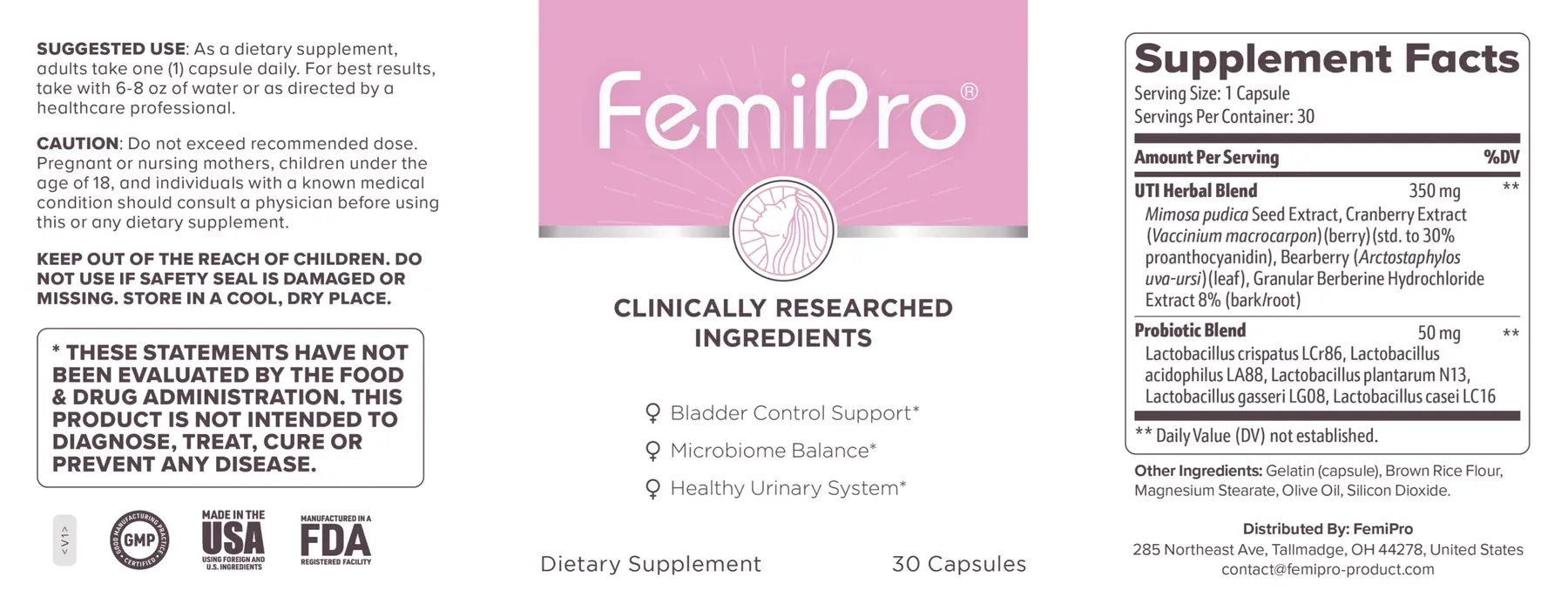
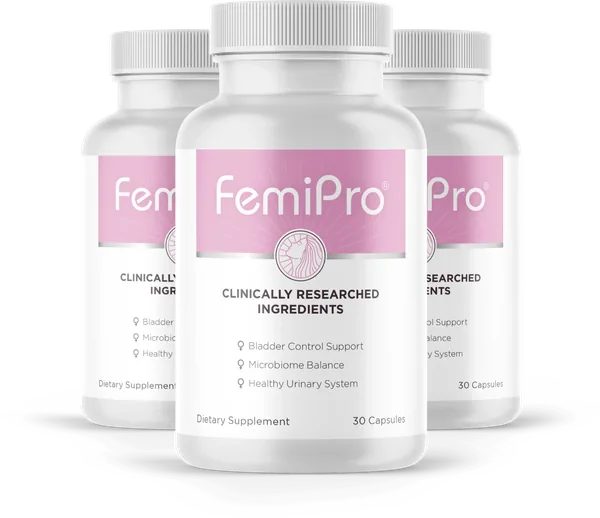
Our own product names five lactobacillus strains and prints a 50 mg blend total with no colony count. We say so on the label page, the testing page and the ingredients page, because it is the most important missing figure on the bottle.
$49 to $69 a bottle · free US shipping · 60-day guarantee
Order FemiproStrain, species, genus
A third distinction, and it changes what a name is worth.
Take Lactobacillus crispatus LCr86. Lactobacillus is the genus, crispatus is the species, and LCr86 is the strain. The evidence lives at the strain level. NCCIH puts it plainly: if a specific kind of lactobacillus helps prevent an illness, that does not mean another kind of lactobacillus, or any bifidobacterium, will do the same.
So a label saying only “probiotic blend” tells you very little. A label naming species tells you more. A label naming strains is doing the best of the three, and it lets you go and look for that strain's trial record, which is the point.
What you often find when you look is nothing. Many strain codes on supplement labels are proprietary designations with no published trials under that name. That is not necessarily bad faith, but it does mean the strain-specific rule cuts against the product: a strain cannot inherit the evidence for a different strain by being the same species.
And when a strain does have trials, check what they did. The main L. crispatus trial in recurrent urinary infection delivered the organism as a vaginal suppository rather than as a capsule, which is a subject we have given a whole post to.
And what a blend total does to all of this
Everything above assumes the label gives you a figure for the probiotic ingredient. A proprietary blend removes even that.
If five strains share a 50 mg total and no individual amount is printed, then in principle 49 mg could be one strain and the remaining four could share a milligram between them. The label is consistent with both that and an even split, and nothing on the outside of the bottle distinguishes them.
Combine that with a missing CFU count and you have a probiotic disclosure with no number in it that can be compared with anything. That is the situation on a great many labels in this aisle, including the one sold here.
Why the count is not the whole story either
Having spent this long arguing that CFU is the number that matters, it would be misleading to stop without saying what a CFU figure still does not tell you. A big number on a label is not the end of the question.
It does not tell you how many survive the journey. Gastric acid and bile kill a large and unstated proportion of swallowed organisms. Two products with identical counts can deliver very different numbers past the stomach depending on the shell, the coating and the preparation, and almost no label quantifies that.
It does not tell you whether they establish anywhere. Most swallowed probiotic organisms are transient: present while you keep taking them, gone within days of stopping. That is not necessarily a failure, since a transient population can still have effects, but it is different from the colonisation the marketing usually implies.
It does not tell you whether the strain does anything. A hundred billion CFU of an organism with no trial record is a hundred billion of an unknown. The count and the evidence are separate questions and a label can pass one while failing the other.
And more is not automatically better. Trials use the doses they use. A product at ten times the trialled count has not been shown to be ten times better, and in this category, as in most, a bigger number on the front is often a marketing decision rather than a clinical one.
So the honest hierarchy runs: a named strain with a published trial, at a count comparable to the one that trial used, guaranteed at expiry, by the route the trial used. Every step down from that is a step further from the evidence, and most products in this aisle are several steps down before you have finished reading the front of the bottle.
A five-question label check
- Is there a CFU count? If not, the probiotic dose is undisclosed regardless of what the milligram figure says.
- Is it guaranteed at expiry or at manufacture? Look for the words. If neither appears, assume at manufacture.
- Are strains named, not just species? A code like LCr86 or LA88 is what you want to see, and then to search for.
- Is a per-strain count given, or only a total? A total across five strains is much weaker than five figures.
- What does the storage line say? Cool and dry is a real instruction for a live product. Follow it.
A product passing all five is unusual. A product passing the first three is doing well.
Our own label, scored
It would be evasive to write all of that and not apply it to the bottle this website sells, so:
| Question | Result | Detail |
|---|---|---|
| Is there a CFU count? | No | Not on the label, not on the sales page. This is the most important missing number on the bottle |
| Guaranteed at expiry or manufacture? | Neither is stated | No count, so no date convention either |
| Are strains named? | Yes, all five | LCr86, LA88, N13, LG08 and LC16. Better than most labels in the aisle |
| Per-strain counts? | No | A 50 mg total for the blend, with no individual figure of any kind |
| Storage instruction? | Yes | Cool and dry, with the seal warning. A real instruction for a live product |
One pass, one partial, three failures. The naming of the strains is genuinely to the product's credit and we will not pretend otherwise. The absence of a count is the reason the probiotic half of that label cannot be compared with any competitor, and it is stated on the label page, the quality page and the buyer's checklist for the same reason.
Sources
- NCCIH, probiotics usefulness and safety. National Center for Complementary and Integrative Health. Probiotics: Usefulness and Safety. National Institutes of Health. View source
- Cochrane review, probiotics and UTI, 2015. Schwenger EM, Tejani AM, Loewen PS. Probiotics for preventing urinary tract infections in adults and children. Cochrane Database of Systematic Reviews. 2015;(12):CD008772. View source
- Stapleton, L. crispatus for recurrent UTI, 2011. Stapleton AE, Au-Yeung M, Hooton TM, et al. Randomized, placebo-controlled phase 2 trial of a Lactobacillus crispatus probiotic given intravaginally for prevention of recurrent urinary tract infection. Clinical Infectious Diseases. 2011;52(10):1212-1217. View source
- FDA, current good manufacturing practice, 21 CFR part 111. U.S. Food and Drug Administration. Current Good Manufacturing Practices (CGMPs) for Food and Dietary Supplements, listing dietary supplements under 21 CFR part 111. View source
- NCCIH, using dietary supplements wisely. National Center for Complementary and Integrative Health. Using Dietary Supplements Wisely. National Institutes of Health. View source

Every page, every journal post, the bottle facts and the ingredients go through review by Dr. Jennifer Roelands, MD before they ship. We write these pages from the printed Femipro bottle and from the Supplement Facts panel photographed in our own stock images, cite public research for cranberry, bearberry, berberine, mimosa pudica and the named lactobacillus strains, and print “not published” wherever a figure is not disclosed rather than estimating it. This label publishes two blend totals and no individual amount, and that fact appears on every page where an ingredient is named. Where the seller’s marketing claims more than the bottle supports, we say so on the page. Corrections are made on the page itself and the review date moves forward. Write to [email protected]. Last reviewed September 2026 by Dr. Jennifer Roelands, MD.