Femipro Official Website › Reading room
Bladder Control, Urgency Or Infection: Telling Three Problems Apart
- Three different complaints get the same supplement sold to them: recurrent infection, urge incontinence and stress incontinence.
- They have three different first-line answers, and two of those answers are free.
- Only one of the three has any supplement evidence worth the name, and it is cranberry for recurrent infection.
- Telling them apart takes one appointment and changes what actually helps.
Why three problems share one shelf
Walk down the urinary aisle in any pharmacy, or scroll any supplement site including this one, and you will find products addressed to something vague: bladder support, urinary health, feminine wellness. The vagueness is not an accident. A dietary supplement may make structure and function claims about supporting a normal function, and it may not claim to treat a disease, so the language has to stay above the level at which specific problems live.
The effect is that three genuinely different complaints get sold the same capsule. Recurrent urinary tract infection, urge incontinence and stress incontinence are not variations on a theme. They have different causes, different first-line treatments and different prospects, and the evidence for a supplement in each of them ranges from reasonable to nonexistent.
This post is about telling them apart, which is worth doing before you spend anything. The NOBLE survey of 5,204 US adults found overactive bladder in 16.9 percent of women, with urge incontinence rising sharply after the age of 44. It also found overactive bladder in 16.0 percent of men, which is worth carrying because this category likes to frame the whole subject as a female problem. What differs is the symptom pattern, not the frequency.
Recurrent infection
This is the one with a bacterial cause. Most uncomplicated urinary tract infections in women begin with E. coli from the gut reaching the urethra and attaching to the lining of the urinary tract. The symptoms are distinctive: burning on passing urine, a frequent urge that produces very little, and sometimes cloudy or strong-smelling urine. Recurrent means several episodes in a year.
It is also the only one of the three with a supplement behind it worth taking seriously. The 2023 Cochrane review pooled 50 randomised trials across 8,857 participants and found cranberry products reduced symptomatic, culture-verified infection, with a risk ratio of 0.70 overall and 0.74 in women with recurrent infection, at moderate certainty. NCCIH puts the effect at around 25 percent in the groups where it works.
Three caveats travel with that. The same review found little or no benefit in elderly institutionalised people, in pregnancy, or in people whose bladder does not empty properly. It found no demonstrable difference between low, moderate and high proanthocyanidin doses, which undercuts the marketing built on standardisation percentages. And prevention is not treatment: NCCIH says directly that cranberry should not be used in place of treating an infection you already have.
Urge incontinence and overactive bladder
This is a signalling problem rather than an infection. The bladder contracts when it should not, producing a sudden urge that is hard to defer, sometimes with leakage before you reach a toilet. There is no burning and no infection. Frequency during the day and waking at night to pass urine often come with it.
The first-line answer here is bladder training, and it comes from a guideline rather than a label. The American College of Physicians recommends bladder training for urgency incontinence, ahead of medication and well ahead of anything sold in a bottle. It is a structured programme of gradually extending the interval between visits, taught by a clinician, and it costs nothing.
What is the supplement evidence for urge incontinence specifically? There is essentially none. No ingredient commonly sold in this aisle has been trialled with urgency as an endpoint. Products are sold to this complaint on the strength of language about bladder control support, which is a structure-function claim rather than a finding. If that is your problem, a capsule is not a bad idea so much as an untested one.
Stress incontinence
This is a mechanical problem. Pressure on the bladder, from a cough, a sneeze, a laugh or lifting something, produces leakage because the pelvic floor is not holding. There is no urge beforehand, which is the clearest distinguishing feature: urge incontinence announces itself, stress incontinence does not. MedlinePlus describes the distinction plainly, and NIDDK names childbirth, menopause and ageing as the usual contributors.
The first-line answer is pelvic floor muscle training, and it has the strongest evidence of anything discussed in this post. The Cochrane review found women doing it were substantially more likely to report cure or improvement, and to have better quality of life, than women who did nothing. Trial programmes generally ran three months or more. The ACP guideline puts it first for stress incontinence.
The supplement evidence for stress incontinence is zero, and it is hard to see how it could be otherwise. The problem is muscular and structural. No capsule has a plausible mechanism for it, and anything sold to it is being sold on the vagueness described at the top of this page.
| Recurrent infection | Urge incontinence | Stress incontinence | |
|---|---|---|---|
| Main symptom | Burning, frequency, little urine passed | Sudden urge that is hard to defer | Leaking on a cough, sneeze or lift |
| Urge beforehand? | Yes, and it is uncomfortable | Yes, strongly | No. This is the clearest distinguishing feature |
| Underlying cause | Bacterial | Bladder signalling | Pelvic floor |
| Guideline first line | Assessment and treatment of the infection | Bladder training | Pelvic floor muscle training |
| Cost of the first line | A clinician's time | Free | Free |
| Supplement evidence | Cranberry, moderate certainty, for prevention only | None with urgency as an endpoint | None |
| Time to judge | Months, because it is a rate | Weeks to months | Three months or more |
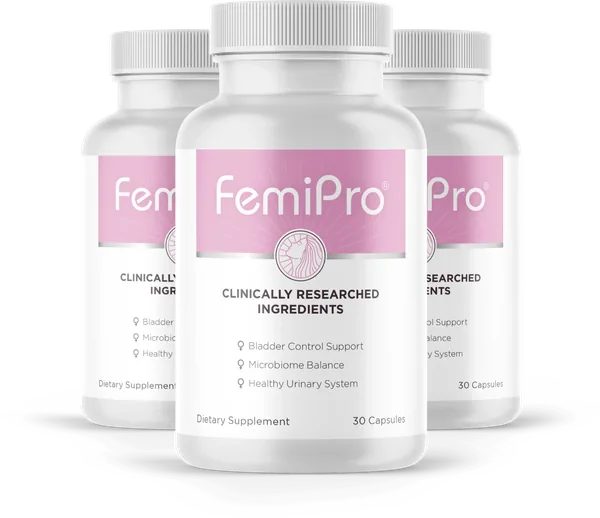
Femipro sits in one of those three columns
The panel is built around cranberry, which is the ingredient with real evidence in the first column and none in the other two. If you know which problem you have, you know how much that is worth to you.
$49 to $69 a bottle · free US shipping · 60-day guarantee
Order FemiproHow to tell which one you have
None of this requires a diagnosis from a website. It requires about ten minutes of paying attention and then, usually, one appointment.
- Is there burning? Burning on passing urine points at infection and away from the other two. It also needs a clinician rather than a shelf.
- Does an urge come first? If leakage is preceded by a sudden, strong need, that is the urge pattern. If it happens on a cough with no warning, that is the stress pattern.
- Does it happen at night? Waking repeatedly to pass urine goes with the urge pattern far more often than the stress one.
- What triggers it? Physical exertion points at the pelvic floor. Running water, cold, or arriving at your own front door points at the urge pattern.
- How often, and for how long? Write it down for a week before the appointment. A clinician can do far more with seven days of notes than with a description from memory.
Plenty of people have a mixture, which is a recognised pattern in its own right and does not mean you have got it wrong. It does mean the answer is likely to be a combination, and that is exactly the kind of judgement a capsule cannot make and a clinician can.
Where a supplement fits, if anywhere
Honestly, in one of the three columns, and alongside rather than instead.
If your problem is recurrent infection, cranberry has real evidence for prevention and a daily capsule is a reasonable thing to add to what a clinician has advised. Read the label for a proanthocyanidin figure, and notice that the Cochrane review found no dose-response for it, so a higher percentage is not automatically better value.
If your problem is urgency or stress leakage, the honest position is that no supplement has been shown to help and the free interventions have. That is an awkward thing to publish on a site that sells one. It is also what the evidence says, and a page that said otherwise would be worth ignoring on cranberry too.
One general habit for the whole aisle: if you take prescription medicine, check the panel with a pharmacist before you start. Several common urinary ingredients, berberine in particular, interfere with how medicines are cleared, and the FDA warns that these combinations can be dangerous.
The symptoms that are not a shelf question
Some things belong with a clinician the same day, not with a supplement page and not with a week of watching:
- Burning that is getting worse rather than better
- Fever, or shivering
- Pain in the back or the flank, especially on one side
- Blood in the urine
- Nausea or vomiting alongside urinary symptoms
- Any urinary symptom during pregnancy
Those can indicate an infection that has reached a kidney. No dietary supplement treats that, and the real danger of a product sold into this space is not that it does nothing but that it feels like doing something while the clock runs.
If you are weighing a specific product, the two guides on this website are written to be useful even if you buy nothing: what the evidence supports across the category, and a ten-point checklist for judging any label, scored against our own product, which fails three of the ten.
Sources
- NOBLE study, overactive bladder in the US, 2003. Stewart WF, Van Rooyen JB, Cundiff GW, et al. Prevalence and burden of overactive bladder in the United States. World Journal of Urology. 2003;20(6):327-336. View source
- Cochrane review, cranberry and UTI, 2023. Williams G, Stothart CI, Hahn D, Stephens JH, Craig JC, Hodson EM. Cranberries for preventing urinary tract infections. Cochrane Database of Systematic Reviews. 2023;11(11):CD001321. View source
- NCCIH, cranberry usefulness and safety. National Center for Complementary and Integrative Health. Cranberry: Usefulness and Safety. National Institutes of Health. View source
- American College of Physicians guideline, 2014. Qaseem A, Dallas P, Forciea MA, et al. Nonsurgical management of urinary incontinence in women: a clinical practice guideline from the American College of Physicians. Annals of Internal Medicine. 2014;161(6):429-440. View source
- Cochrane review, pelvic floor muscle training, 2018. Dumoulin C, Cacciari LP, Hay-Smith EJC. Pelvic floor muscle training versus no treatment, or inactive control treatments, for urinary incontinence in women. Cochrane Database of Systematic Reviews. 2018;10:CD005654. View source
- MedlinePlus, urinary incontinence. MedlinePlus. Urinary Incontinence. National Library of Medicine, National Institutes of Health. View source
- NIDDK, bladder control problems in women. National Institute of Diabetes and Digestive and Kidney Diseases. Bladder Control Problems (Urinary Incontinence). National Institutes of Health. View source
- FDA, mixing medicines and supplements. U.S. Food and Drug Administration. Mixing Medications and Dietary Supplements Can Endanger Your Health. View source

Every page, every journal post, the bottle facts and the ingredients go through review by Dr. Jennifer Roelands, MD before they ship. We write these pages from the printed Femipro bottle and from the Supplement Facts panel photographed in our own stock images, cite public research for cranberry, bearberry, berberine, mimosa pudica and the named lactobacillus strains, and print “not published” wherever a figure is not disclosed rather than estimating it. This label publishes two blend totals and no individual amount, and that fact appears on every page where an ingredient is named. Where the seller’s marketing claims more than the bottle supports, we say so on the page. Corrections are made on the page itself and the review date moves forward. Write to [email protected]. Last reviewed September 2026 by Dr. Jennifer Roelands, MD.